Key Takeaways: Self-destructing links with encryption and access controls help lawyers protect client confidentiality and preserve attorney-client privilege. This article is for lawyers, paralegals, law firm administrators, and anyone handling legal documents who needs to understand time-limited sharing.
The Legal Industry Is Under Attack
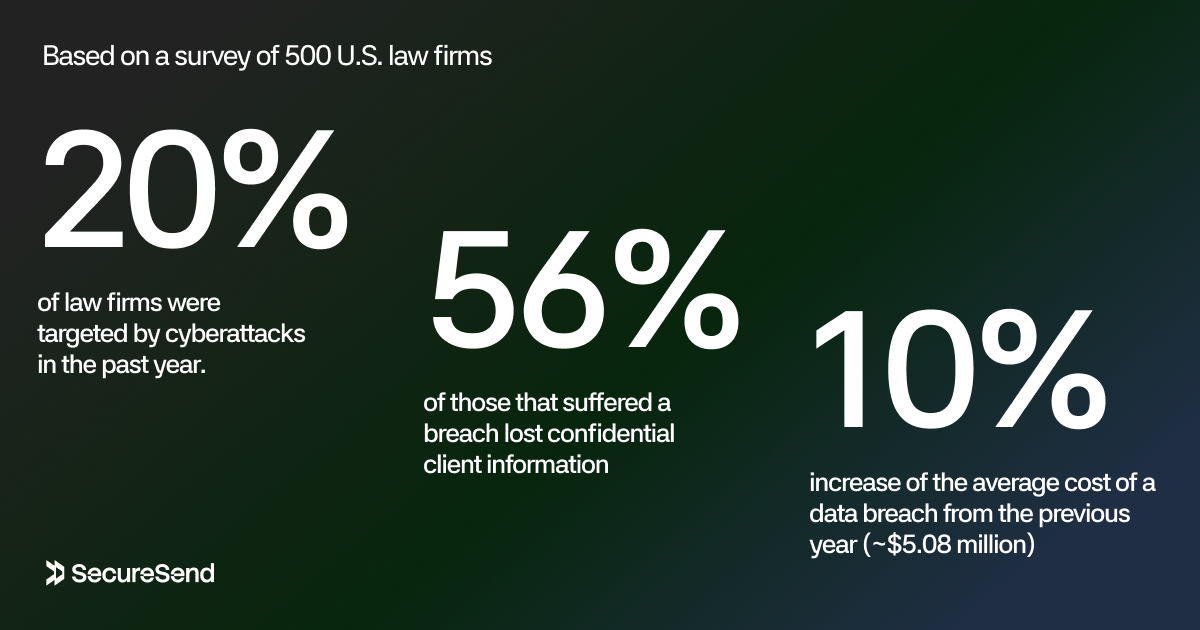
Law firms have become prime targets for cybercriminals, and the numbers tell a sobering story. In a recent survey of 500 U.S. law firms, 20% reported being targeted by cyberattacks in the past year. Of those that suffered a breach, 56% lost confidential client information. The average cost of a data breach for a law firm now sits at approximately $5.08 million, a 10% increase from the previous year.
These statistics represent real firms, real clients, and real consequences. When a breach exposes privileged communications, the damage extends far beyond financial loss. Client trust erodes. Regulatory investigations begin. Malpractice exposure increases. Reputations built over decades can unravel in a single incident.
Why are law firms such attractive targets? They sit at the center of sensitive transactions. Mergers and acquisitions, litigation strategy, financial disclosures, medical records, intellectual property, and personal identifying information all flow through law firm systems. A single compromised email account can expose hundreds of clients. A misconfigured cloud storage folder can publish privileged documents to the open internet.
The legal industry also faces an average of 1,055 attacks per week, up 13% since 2024. Ransomware attacks on law firms rose 11% year-over-year, with 1.5 million legal records compromised in a single year. Attackers know that law firms often lack dedicated cybersecurity teams and prioritize billable hours over security updates. A successful breach can yield data worth far more than the ransom demand.
Against this backdrop, the way lawyers share documents matters enormously. Every contract, every deposition, every medical record, every wire instruction sent through an insecure channel is a potential liability. Self-destructing links offer a practical, proven way to reduce that exposure without adding friction to legal workflows.
Why Email Attachments and Consumer Cloud Tools Fail Lawyers
Despite the risks, many lawyers still default to email attachments for routine document exchange. It is familiar, fast, and requires no additional software. But email was never designed for privileged or regulated information.
Standard email encrypts messages in transit using TLS, but the protection ends there. Messages and attachments sit unencrypted on mail servers. They sync to mobile devices. They forward to colleagues, assistants, and family members with a single click. Once sent, an attachment cannot be recalled, revoked, or audited. If the recipient's account is compromised six months later, every attachment you ever sent them is now in the attacker's hands.
Consumer cloud tools like Google Drive, Dropbox, and WeTransfer present a different but equally serious problem. These services encrypt files at rest and in transit, but they hold the decryption keys. Their employees can access your files. A hacker who breaches their infrastructure can too. A government agency with a subpoena can compel them to produce your data. The "anyone with the link" sharing model that makes these tools convenient also makes them dangerous. Links get forwarded, copied into chat messages, and posted in places they should never appear. There is no expiration, no revocation, and no meaningful audit trail.
The Pennsylvania Bar Association's Formal Opinion 2022-400 and similar guidance from state bars across the country increasingly warn against these practices. ABA Formal Opinion 477R, which addresses securing communication of protected client information, makes clear that lawyers must undertake reasonable efforts to prevent inadvertent or unauthorized access. As threats evolve, what counts as "reasonable" evolves with it. In 2026, sending privileged documents as unencrypted email attachments or through consumer cloud links is increasingly difficult to defend as a reasonable safeguard.
The alternative is to adopt tools designed specifically for the risks lawyers face, rather than abandoning digital sharing. Self-destructing links represent one of the most effective and practical controls available.
Attorney-Client Privilege in the Digital Age
Attorney-client privilege remains one of the most sacred protections in the legal system. It encourages clients to speak freely with their lawyers by ensuring those communications remain confidential. But privilege is not automatic. It must be preserved through reasonable efforts to maintain confidentiality.
Courts have long held that privilege can be waived through disclosure to third parties. When a lawyer sends a privileged document through a channel that exposes it to unnecessary intermediaries, the question of waiver becomes real. Cloud email providers process and store the message. Consumer file-sharing platforms may scan content for abuse detection or machine learning training. Public generative AI systems, if used to summarize or analyze client documents, can treat the input as non-confidential training data.
Bar associations have responded with increasingly specific guidance. Lawyers must understand the technologies they use. They must read terms of service. They must avoid platforms that do not provide adequate confidentiality or encryption. They must document their security practices. The duty of competence under Model Rule 1.1 now explicitly includes understanding the benefits and risks of relevant technology.
Self-destructing links help preserve privilege by design. The document resides in an encrypted environment. Access is granted through a time-limited, password-protected URL that can be restricted to specific recipients. The link expires automatically, removing the access path without destroying the underlying record. The lawyer retains control over who sees what, for how long, and under what conditions. If a link is sent to the wrong address, it can be revoked instantly. If a matter closes, all associated links can be deactivated in seconds.
This level of control supports the argument that the lawyer took reasonable steps to maintain confidentiality. It demonstrates a deliberate, documented approach to protecting privileged communications rather than a casual reliance on general-purpose tools.
What Self-Destructing Links Actually Do
A self-destructing link is a URL that automatically becomes unusable after specific conditions are met. The most common conditions are time-based expiration, access-count limits, or manual revocation by the sender. When the condition triggers, the link stops working. Anyone who tries to use it sees an expiration notice or an error page. The underlying document remains intact in the sender's secure storage, but the access path has been destroyed.
Here is how a well-designed self-destructing link system works in practice:
Encryption before upload. The document is encrypted on the sender's device using AES-256 or equivalent before it ever reaches the server. The service provider stores only ciphertext. They cannot read the document, even if compelled.
Unique token generation. The sharing link contains a cryptographically random token that is impossible to guess. The token maps to the encrypted document in the backend system. Without the token, the document is unreachable.
Configurable expiration. The sender sets when the link dies. Options typically include absolute time-to-live, such as 24 hours or seven days, or relative time after first access, such as five minutes after the recipient opens it. Some systems also support access-count limits, allowing exactly one download before the link self-destructs.
Password protection. The link can require a separate password that the sender communicates through a different channel, such as SMS or a phone call. Even if the link is intercepted, the password remains unknown.
Activity logging. Every access attempt is recorded with timestamp, IP address, device information, and action type. The sender can see who opened the document, when, from where, and whether they downloaded it.
Instant revocation. If circumstances change, the sender can deactivate the link immediately with a single click. This is useful when a deal falls through, an employee leaves, or a link was sent to the wrong recipient.
These features combine to create a sharing model that is fundamentally different from email attachments or open cloud links. The document is encrypted, access is controlled and time-bound, and the sender maintains visibility and control throughout the document's lifecycle.
How Self-Destructing Links Align with Ethics and Compliance
Lawyers operate under multiple overlapping obligations: professional ethics rules, state bar guidance, client expectations, and sectoral regulations like HIPAA, GDPR, and CJIS. Self-destructing links help satisfy all of them.
ABA Model Rule 1.6 and state equivalents require lawyers to make reasonable efforts to prevent the inadvertent or unauthorized disclosure of client information. ABA Formal Opinion 477R establishes a fact-specific standard that considers the sensitivity of the information, the likelihood of disclosure, the cost and difficulty of safeguards, and the extent to which safeguards impede the lawyer's ability to represent the client. Self-destructing links score well on every factor. They provide strong protection for highly sensitive information. They reduce the likelihood of disclosure by limiting access windows. They are inexpensive and easy to use. And they integrate seamlessly into existing workflows.
GDPR's data minimization and storage limitation principles require organizations to limit personal data to what is necessary and avoid retaining it longer than needed. Self-destructing links embody these principles directly. By automatically deactivating after a set period, they prevent the long-term accumulation of sensitive data on third-party systems. When combined with client-side encryption, they ensure that personal data is never stored in plaintext on provider infrastructure.
HIPAA's technical safeguards for protected health information require access controls, encryption, audit controls, and integrity measures. Updated 2026 guidance further mandates universal multi-factor authentication, comprehensive audit trails with real-time alerts, and time-limited sharing capabilities with automatic link expiration. Self-destructing links with activity logging and MFA support directly operationalize these requirements.
CJIS and evidence-handling standards for criminal justice matters demand documented chain of custody, tamper detection, and strict per-recipient access controls. Evidence link platforms use tokenized URLs tied to specific recipients, time-limited activation windows, IP restrictions, hash-verified integrity, and immutable access logs. Self-destructing behavior ensures that evidence remains accessible only during defined windows, reducing the risk of unauthorized access or accidental disclosure.
State bar ethics opinions increasingly recommend specific technical measures. The North Carolina State Bar advises lawyers to look for email encryption tools that allow expiration dates, self-destruction, recall options, and "do not forward" rules. Texas Ethics Opinion 648 outlines circumstances where encryption is warranted for confidential information. Multiple state bars now recommend secure client portals or encrypted link-based sharing over routine email attachments for sensitive documents.
By adopting self-destructing links, lawyers can point to concrete, documented safeguards when questioned by regulators, courts, or clients. The technology becomes evidence of due care.
Real-World Scenarios: When Lawyers Need Time-Limited Sharing
Theory is useful, but practice is what matters. Here are specific situations where self-destructing links transform risky sharing into controlled, defensible exchange.
Wire Instructions and Financial Disclosures
Bar associations explicitly advise against sending wire instructions via ordinary email due to business email compromise schemes. A better approach is to host the instructions in a secure platform and share them through a time-limited, password-protected link that expires shortly after the client accesses it. The password is communicated by phone. Once the client confirms receipt, the link self-destructs. Access logs provide a record that the correct recipient retrieved the information at a specific time, which can help resolve fraud disputes.
Medical Records in Litigation
Personal injury cases require sharing medical records with defense counsel, expert witnesses, and insurers. These records constitute protected health information under HIPAA. Email attachments or open cloud links make it difficult to demonstrate compliance. Using a secure platform, plaintiff's counsel uploads the records into an encrypted repository and creates per-recipient links for each external party. Each link expires after seven days or a single download. Access reasons can be logged. Audit trails record every view with identity, timestamp, and IP address. When the case settles, remaining links are revoked. This operationalizes the principle of minimum necessary disclosure.
Draft Contracts and Settlement Agreements
Negotiating a merger or settlement involves exchanging draft documents that contain sensitive financial data, strategic positions, and personal information. These drafts evolve rapidly. A version shared by email lives forever in the recipient's inbox, even after the final agreement is signed. Self-destructing links ensure that draft versions become inaccessible once their purpose is served. If negotiations break down, the opposing party cannot retain ongoing access to documents that were shared in confidence.
Client Onboarding and Identity Verification
Law firms routinely collect passport scans, driver's licenses, and financial statements during client intake. These documents are goldmines for identity thieves. Sharing them through email creates permanent copies on mail servers and devices. A self-destructing link with one-time download access ensures the document is transmitted securely and then disappears from the access path. The firm retains the original in its secure document management system. The client knows their sensitive information is not floating around in email inboxes indefinitely.
Expert Witness Materials
Sharing litigation strategy, deposition transcripts, or expert reports with testifying witnesses requires careful control. These materials are protected by work-product doctrine and must not reach opposing counsel. A self-destructing link with device binding and IP restrictions ensures that only the intended expert can access the materials, from their known location, for a limited time. If the expert's account is later compromised, the expired link provides no value to the attacker.
Best Practices for Implementing Self-Destructing Links in Your Firm
Adopting self-destructing links is not just a technology decision. It requires policy, training, and integration into existing workflows.
Choose a purpose-built secure sharing platform. Consumer tools lack the encryption architecture, access controls, and audit capabilities that legal work demands. Look for platforms that offer client-side AES-256 encryption, customizable expiration, password protection, and activity logging. A provider that publishes transparent security documentation, explains its key management, and invites vulnerability disclosure often demonstrates more confidence than one that relies solely on certification badges. Compliance certifications such as SOC 2 or ISO 27001 can provide additional assurance, but they should supplement, not replace, a verifiable technical security model. The platform should make secure sharing as easy as attaching a file to email, or lawyers will revert to old habits.
Establish clear policies. Define which documents must be shared through secure links versus which can use routine channels. Wire instructions, medical records, draft agreements, and identity documents should always use time-limited sharing. Routine scheduling emails may not require it. Document these policies in writing and make them part of firm onboarding.
Train everyone. Associates, paralegals, secretaries, and partners all need to understand why secure links matter and how to use them. Training should cover phishing awareness, proper recipient verification, password communication protocols, and when to revoke links. Emphasize that consumer cloud tools are not acceptable substitutes for legal documents.
Communicate passwords separately. Never send the link password in the same email as the link itself. Use SMS, phone calls, or secure messaging apps. This simple practice prevents a compromised email account from yielding both the document and the key.
Set short expiration by default. Configure your sharing platform to default to the shortest practical timeframe. You can always extend or create a new link if needed. It is far easier to grant additional access than to recover from an unauthorized disclosure.
Monitor and audit. Review access logs regularly. Look for unusual patterns, such as downloads from unexpected locations or at odd hours. Set up alerts for failed access attempts. These logs are not just security tools. They are compliance evidence.
Integrate with your document management system. Self-destructing link functionality should be accessible from the tools lawyers already use. If sharing securely requires switching applications, copying files, or creating separate accounts, adoption will suffer. The best platforms offer plugins or APIs for popular legal DMS and practice management systems.
Plan for litigation holds. Self-destructing links control access paths, not underlying records. Your firm's document management system must retain authoritative copies according to retention schedules and litigation hold requirements. When a hold is issued, suspend auto-deletion policies that might affect relevant records. The link can expire, but the document must remain preserved.
FAQ: Common Questions About Self-Destructing Links for Legal Documents
Are self-destructing links legally defensible for attorney-client privilege?
Yes. Courts and bar associations evaluate whether lawyers took reasonable steps to maintain confidentiality. Self-destructing links with encryption, access controls, and audit trails demonstrate a deliberate, documented effort to protect privileged communications. They are far easier to defend than email attachments or open cloud links.
What happens if a recipient needs access after the link expires?
The sender can generate a new link instantly. This is a feature, not a bug. The expiration forces a conscious decision to reauthorize access, which reduces the risk of stale, forgotten links remaining active indefinitely.
Can recipients copy or screenshot documents before the link expires?
Yes. Recipients can download, print, or photograph documents while access is available. Digital watermarking can embed recipient-specific identifiers that deter misuse, but no technical control can fully prevent copying. Self-destructing links should be viewed as one layer in a defense-in-depth strategy, not a guarantee of absolute secrecy.
Do self-destructing links satisfy HIPAA requirements for sharing PHI?
When implemented correctly, yes. HIPAA requires encryption, access controls, audit trails, and time-limited sharing for protected health information. Self-destructing links with AES-256 encryption, MFA, activity logging, and automatic expiration directly address these requirements. Ensure your platform has undergone HIPAA compliance verification.
Can self-destructing links be used during litigation holds?
The link expiration affects external access, not the underlying document. Your firm's document management system should retain the document according to retention policies and litigation hold requirements. When a hold is in place, ensure that auto-deletion policies affecting the underlying record are suspended. The access link can expire while the document remains preserved.
Are self-destructing links difficult for clients to use?
No. Modern secure sharing platforms make the experience identical to clicking any other link. The recipient opens the URL in their browser, enters a password if required, and views or downloads the document. The encryption and expiration happen invisibly in the background. No software installation, no technical expertise, no friction.
How do self-destructing links compare to secure client portals?
Client portals provide persistent, authenticated access to a centralized document repository. Self-destructing links provide temporary, tightly controlled access to specific documents. They are complementary. Portals work well for ongoing client relationships. Self-destructing links work well for one-time exchanges, external parties who do not need portal accounts, and situations where time-limited access is essential.
What should I look for in a self-destructing link platform?
Prioritize client-side encryption, AES-256 or equivalent, customizable expiration, password protection, one-time download options, detailed activity logging, instant revocation, MFA support, and compliance certifications. Avoid platforms that are vague about their encryption methods or store your files in plaintext.
Conclusion: Make Time-Limited Sharing Your Default
The legal profession faces a simple reality. Cyberattacks are increasing. Client expectations are rising. Regulatory scrutiny is intensifying. And the tools that most lawyers grew up using, email attachments and consumer cloud links, were never designed for the risks of 2026.
Self-destructing links offer a way forward that is both practical and principled. They protect attorney-client privilege by limiting access windows and documenting safeguards. They align with ethics opinions that increasingly expect encryption, expiration, and audit trails. They satisfy regulatory frameworks from HIPAA to GDPR to CJIS. And they give lawyers and their clients confidence that sensitive documents are shared with intention, not by accident.
The shift does not require abandoning familiar workflows. It requires choosing a secure sharing platform that makes time-limited links as easy to create as email attachments. Upload a document. Set an expiration. Share the link. Your recipient clicks, views, and the access path disappears. The document remains secure in your system. The exposure window closes.
Your clients trust you with their most sensitive information. That trust deserves better than an email attachment that lives forever in someone else's inbox.
Ready to protect your legal documents with bank-grade encryption, self-destructing links, and complete access control? Create your first secure file sharing link with SecureSend and experience effortless, ultra-secure document sharing built for the demands of legal practice in 2026.
Sources: ABA Formal Opinion 477R, Pennsylvania Bar Association Formal Opinion 2022-400, Texas Ethics Opinion 648, North Carolina State Bar Ethics Opinion on Encrypting Communications, Embroker Law Firm Cyberattack Statistics 2026, Tech Advisors Legal Sector Security Report 2025, Law.com Cybersecurity Survey 2025, U.S. Legal Support Data Privacy Forecast 2026.